
Every factory wants to be “data-driven.” Sensors are added, dashboards multiply, and teams talk about predictive maintenance and AI readiness. But ask how many of those systems are actually producing reliable insights — and most manufacturers will admit that they’re still flying blind.
The reason isn’t always a lack of data. More often, it’s the wrong kind of data.
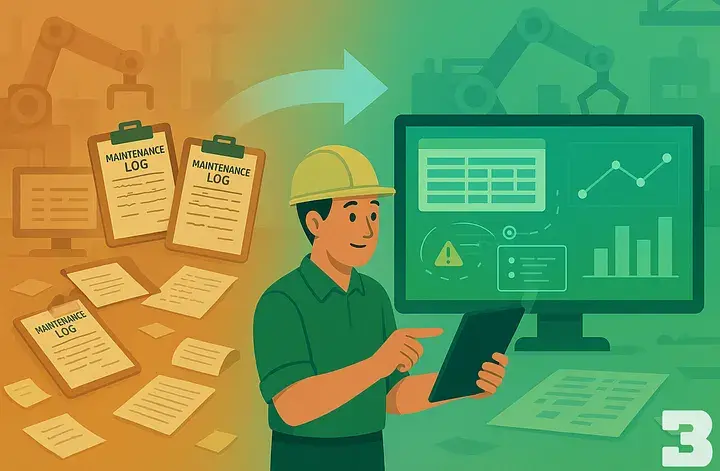
Factories already have years of maintenance logs, operator notes, and quality reports that contain real insight — they’re just scattered, inconsistent, or forgotten. Turning that existing history into usable intelligence is often more valuable than adding another terabyte of unlabeled sensor data.
Rethinking Data Requirements
The industry has been sold a narrative: that you need massive datasets to do AI. In reality, most machine-learning projects in manufacturing never approach the data volume of consumer applications. For many predictive maintenance use cases, you don’t need millions of samples to detect recurring patterns in equipment failure — you need several dozen well-documented examples with proper context.
A handful of high-quality, context-rich records often provides more value than gigabytes of raw sensor noise. A maintenance log with the date, part, fault description, technician’s notes, and operational context can teach an algorithm what failure progression looks like. Aggregate that across several months of operations, and you have a dataset that may be small in volume but rich in signal.
The Value in Maintenance Logs
Every time a technician writes “motor replaced due to vibration,” that’s labeled data. Every note about a “recurring alarm on pump #4” is a pattern waiting to be quantified. Maintenance logs are essentially a slow-motion time series — a history of what’s gone wrong, when, and under what conditions.
When properly cleaned and structured, this kind of operational data becomes the foundation for practical AI applications.
Consider a packaging line that repeatedly trips at one station. By linking maintenance logs with sensor readings from those periods, the system can start identifying precursors: vibration exceeding a threshold, followed by temperature spike, then stoppage. That insight doesn’t require billions of datapoints — it requires fifty well-documented incidents with proper context.
From Logs to Learning: The Process
The transformation process is methodical but not simple:
Digitize and standardize existing records: Convert handwritten logs or scattered spreadsheets into structured databases with consistent fields and timestamps. This step alone can take weeks or months depending on record quality and volume.
Add operational context: Link failures to production conditions, shift patterns, product types, or environmental factors. Even basic context like “night shift” or “high humidity period” can improve model accuracy.
Label outcomes clearly: Identify which entries represent actual faults, preventive maintenance, inspections, or false alarms. Consistent labeling is critical and often requires domain expertise.
Start with descriptive analytics: Before jumping to prediction, use the data to understand failure patterns, mean time between failures, and common precursors. This builds confidence in data quality.
Develop predictive models gradually: Once patterns are clear and data quality is verified, introduce machine learning models that can flag early warning signs or correlate symptoms with root causes.
Establish feedback loops: Each time a prediction is confirmed or disproven, capture that outcome to improve the model. This requires ongoing process discipline.
The objective isn’t perfection on day one. It’s building a system that learns incrementally and improves over time.
Quality Over Quantity
Research on manufacturing AI implementations consistently shows that projects stall more often due to data quality issues than insufficient volume. Inconsistent units of measurement, missing timestamps, unclear failure definitions, and human recording errors create more problems than limited sample sizes.
The real challenge isn’t collecting more data — it’s governing what you already have.
Consider these hypothetical scenarios that illustrate the approach:
A sawmill might reduce unplanned downtime by 20% using six months of maintenance logs combined with temperature and vibration readings — if those logs are clean, consistently formatted, and properly linked to sensor data.
A food processor could potentially predict packaging defects using 200 well-labeled events rather than thousands — provided each event includes operator observations, sensor readings, and confirmed outcomes.
A steel plant could forecast compressor maintenance windows with high accuracy using 18 months of fault data — assuming that data includes failure modes, operating conditions, and maintenance actions taken.
Each scenario depends not on data volume, but on data quality and proper integration of human knowledge with machine observations.
Why Small, Structured Data Works in Manufacturing
Factories are inherently high-context environments. Equipment ages differently based on usage patterns. Operating conditions fluctuate. Operators adapt based on experience. That human knowledge layer gives structured operational datasets a density of meaning that raw sensor streams alone can’t match.
Small data approaches work best when:
- You already understand common failure modes but need to identify early indicators
- Data sources are limited but carry operational meaning
- Domain experts can guide which variables matter and why
- The goal is specific prediction tasks rather than general pattern discovery
This is where manufacturing has an advantage over generic AI applications. Operators, engineers, and maintenance teams already understand the problem space — they need tools to systematically capture and analyze what they already know.
The Implementation Reality
The path forward requires deliberate investment and realistic expectations:
Start with a specific problem: Choose one asset with a known recurring issue. Don’t try to instrument the entire plant at once.
Assess your data baseline: Review what maintenance records actually exist. How complete are they? How consistent is the terminology? This assessment often reveals the real scope of work required.
Invest in data infrastructure: You’ll need systems to capture, store, and query maintenance data consistently going forward. This isn’t just technology — it’s process change.
Plan for data cleaning: Expect to spend 60–70% of project time on data preparation, cleaning, and validation. This is normal and necessary.
Build internal capability: Someone needs to own this work ongoing — whether that’s upskilling existing staff or hiring data-focused roles. One-time consulting projects rarely create lasting capability.
Set realistic timelines: From decision to first useful predictions typically takes 6–12 months, not weeks. The value compounds over time as data quality improves and models learn.
Prepare for cultural change: Getting technicians to log consistently, operators to trust predictions, and managers to act on insights requires change management, not just technology deployment.
Moving Forward
Manufacturing doesn’t need Silicon Valley-scale data infrastructure. It needs reliable, interpretable data that reflects how operations actually run.
The next wave of practical AI in industry will come from manufacturers who systematically structure the operational knowledge they already possess — maintenance histories, operator observations, and process documentation that currently exists in inconsistent formats across file cabinets and spreadsheets.
This work isn’t glamorous. It requires patience, discipline, and realistic expectations about timelines and complexity. But for manufacturers ready to make that investment, the operational intelligence locked in existing maintenance data represents one of the highest-value opportunities in the plant.
The question isn’t whether your factory has valuable data. It’s whether you’re ready to do the hard work of making that data usable.