

Manufacturers have never had more data. MES platforms, ERP systems, historians, SCADA networks, sensors, and spreadsheets all generate valuable information every day. Yet despite this abundance of data, many organizations still struggle to answer a simple question: Are all our plants measuring performance the same way?
Key Takeaways: How Operational Intelligence Improves Plant KPIs
- Manufacturing operational intelligence unifies data from MES, ERP, SCADA, and historians to create consistent KPI definitions across facilities.
- B3 Systems enables manufacturers to standardize performance metrics across plants, eliminating the confusion caused by fragmented reporting systems.
- Real-time operational visibility allows plant managers to identify and address performance gaps before they affect production targets.
- Common KPI inconsistencies stem from different time bases, state definitions, and calculation methods between systems.
- A unified data approach reduces manual reconciliation work and builds trust in cross-plant performance comparisons.
What Is Manufacturing Operational Intelligence?
Manufacturing operational intelligence (OI) refers to the collection, processing, and analysis of real-time operational data from your factory floor. Unlike traditional business intelligence that focuses on historical financial data, OI targets the live events happening across your production lines, equipment, and workflows.
According to AWS, operational intelligence uses real-time data collection and analysis to proactively discover operational trends, anticipate issues, and help frontline workers make better decisions for troubleshooting and maintenance.
For manufacturers running multiple plants, OI becomes your window into what's actually happening at each facility—right now, not last week. B3 Systems helps you centralize this operational data so your teams can act on current conditions rather than outdated reports.
Why Do KPIs Become Inconsistent Across Plants?
When you operate several manufacturing facilities, KPI inconsistency creeps in faster than you might expect. Each plant often develops its own way of measuring performance, creating a patchwork of definitions that makes cross-facility comparisons unreliable.
Different Names for the Same Metrics
One plant might report "availability" while another tracks "uptime" and a third measures "run ratio." All three describe similar concepts, but subtle differences in calculation make them incompatible for benchmarking.
Inconsistent Time Bases
Some systems calculate KPIs using calendar time. Others use shift time or only count scheduled production hours. When your plants use different time frameworks, your aggregate reports tell you very little about actual performance.
Varying Inclusion Rules
Does planned maintenance count as downtime? What about changeovers? Different facilities answer these questions differently, making your "downtime" numbers inconsistent across locations.
How Does Fragmented Data Affect Multi-Plant Operations?
The consequences of inconsistent KPIs extend far beyond confusing reports. When your data doesn't align, decision-making suffers at every level of your organization.
Plant managers spend hours reconciling conflicting numbers instead of improving processes. Corporate leadership receives reports that look precise but actually mask significant performance variations. Resource allocation decisions get made on incomplete information.
Research from NetSuite indicates that unplanned downtime costs the world's largest companies approximately 11% of their revenue. When your KPI definitions vary across plants, you can't accurately identify which facilities contribute most to this loss.
What Role Does Data Integration Play in KPI Standardization?
Standardizing KPIs requires more than agreeing on definitions—you need a technical foundation that brings data together from disparate sources. Most manufacturers run a mix of systems from different eras and vendors, each tracking performance in its own way.
Your ERP handles orders and financial data. MES platforms track production execution. SCADA systems monitor equipment states. Historians store time-series data. Each system has valuable information, but they rarely speak the same language.
B3 Systems connects your industrial systems—PLC, MES, ERP, and historians—into a unified data environment. This integration creates a single source of truth where KPIs mean the same thing regardless of which plant generates them.
How Can You Establish Consistent KPI Definitions?
Creating enterprise-wide KPI consistency starts with agreeing on what each metric actually measures. Standards like ISO 22400 offer a shared vocabulary for manufacturing performance indicators.
Standardize State Terminology
Define common equipment states—RUN, IDLE, STOP, SLOW—that all facilities use consistently. This alignment ensures that time-derived KPIs get calculated the same way everywhere.
Agree on Time Structures
Document whether your KPIs use shift time, calendar time, or order-based periods. Apply these definitions uniformly across all plants.
Create a Central KPI Catalog
Maintain a documented reference that specifies each metric's name, calculation method, units, and applicable context. Update this catalog through a formal change management process.
What Benefits Does Operational Intelligence Bring to Multi-Plant Visibility?
When your operational data flows into a unified platform, several improvements become possible that directly affect your bottom line.
Real-time monitoring replaces retrospective analysis. Instead of discovering last month's problems through static reports, you can watch current performance and intervene early. B3 Systems delivers 24-hour operational awareness so your teams know what's happening at every facility around the clock.
Cross-plant benchmarking becomes meaningful. With standardized KPIs, you can legitimately compare OEE, throughput, and quality metrics across facilities. This visibility helps you identify which plants have solved problems that others still face.
Resource allocation improves. When you trust your data, you can make confident decisions about where to invest in equipment, training, or process improvements.
How Do You Implement Operational Intelligence for KPI Consistency?
Moving from fragmented data to unified operational intelligence requires a structured approach. Rushing the implementation often creates new problems instead of solving existing ones.
Audit Your Current Data Sources
Document where your data lives today—ERP, MES, spreadsheets, historians, local databases. Assess data quality and note inconsistencies between plants. This audit reveals the scope of your integration challenge.
Define Your Target KPIs
Work with operations leaders to identify which metrics matter most for your business decisions. Focus on 5-7 core KPIs rather than tracking everything. Common choices include OEE, schedule attainment, first-pass yield, and unplanned downtime.
Build Your Integration Architecture
Establish connections between your operational systems and a central data platform. B3 Systems works with your existing infrastructure—you don't need to replace your current MES, SCADA, or historian systems to gain unified visibility.
Validate and Iterate
Run parallel calculations using old and new methods. Investigate discrepancies until you understand their sources. Refine your approach based on what you learn during pilot deployments.
What Obstacles Should You Anticipate?
Implementing operational intelligence across multiple facilities involves predictable challenges. Knowing what to expect helps you plan appropriately.
Resistance to Standard Definitions
Plant managers may feel that standardized KPIs don't capture their unique circumstances. Address this concern by including custom metrics alongside your standardized core set. Make clear which KPIs support cross-plant comparison and which serve local needs.
Legacy System Limitations
Older equipment may not export data easily. Work with your integration platform to find creative solutions—manual data entry, intermediate databases, or sensor retrofits where appropriate.
Data Quality Issues
Poor source data produces unreliable KPIs regardless of how well you standardize definitions. Invest time in cleaning and validating your data before building dashboards that depend on it.
How Does AI Enhance Operational Intelligence?
Modern operational intelligence platforms incorporate AI and machine learning to extract more value from your unified data. These capabilities go beyond simple reporting to actively support decision-making.
Anomaly detection establishes baselines for normal operations at each facility. When performance deviates from expected patterns, the system alerts your team before small problems become major disruptions.
Predictive capabilities help you anticipate equipment failures based on operating conditions rather than fixed maintenance schedules. This approach reduces unplanned downtime while avoiding unnecessary preventive maintenance.
B3 Systems brings AI-powered workflows to your manufacturing operations, helping you move from reactive troubleshooting to proactive optimization. Your teams can focus on improving processes instead of constantly fighting fires.
FAQs about Manufacturing Operational Intelligence and KPI Consistency
What is the difference between operational intelligence and business intelligence?
Business intelligence analyzes historical data—typically financial metrics—to support strategic planning. Operational intelligence focuses on real-time operational data to support immediate decisions on the factory floor. B3 Systems brings these perspectives together so you can see both current conditions and long-term trends.
How long does it take to standardize KPIs across multiple plants?
Timeline depends on your starting point and scope. Defining standard metrics typically takes weeks. Implementing the technical integration can take months, depending on system complexity. B3 Systems works with your existing infrastructure to accelerate deployment without requiring complete system replacement.
Which KPIs should manufacturers prioritize for cross-plant comparison?
Start with OEE (Overall Equipment Effectiveness), schedule attainment, first-pass yield, and unplanned downtime. These metrics directly connect to productivity, quality, and cost outcomes. B3 Systems helps you track these indicators consistently across all your facilities.
Can small manufacturers benefit from operational intelligence?
Absolutely. Even single-facility operations gain value from unified data and real-time visibility. As you grow, having standardized KPIs from the beginning prevents the fragmentation problems that plague larger organizations. B3 Systems scales with your operations from one plant to many.
How does operational intelligence support workforce empowerment?
When frontline workers have access to real-time performance data, they can make better decisions without waiting for supervisor approval. B3 Systems delivers AI insights to your shop floor teams, reducing cognitive load and enabling human-machine collaboration that improves outcomes.
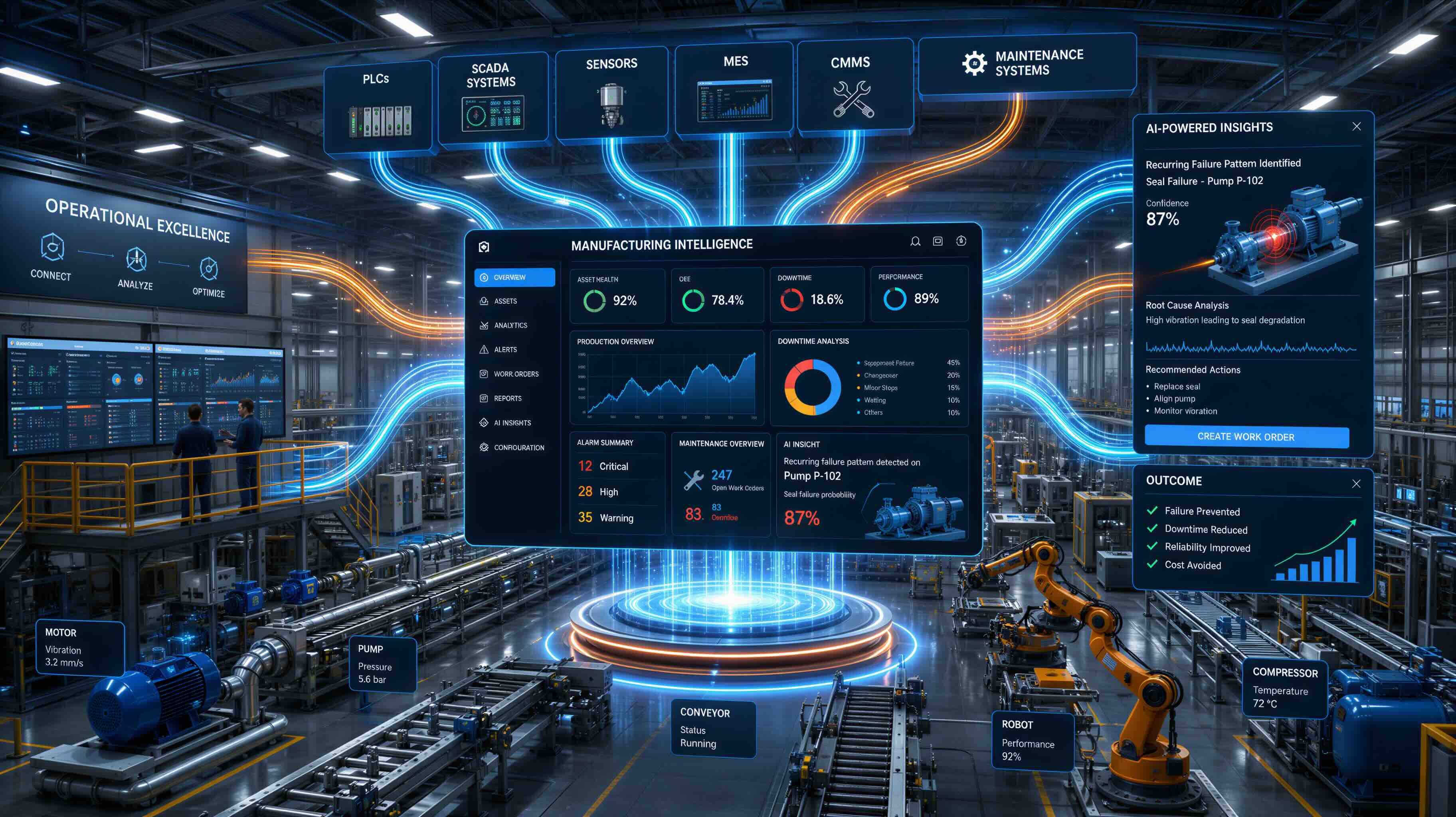
How manufacturers connect data, teams, and operations on one platform.
Request a demo →Written by Yanis Sisalah, B3 Systems


Comments
Your email won't be published.