
For over a century, manufacturing has evolved around one recurring idea: automation makes work easier. From the assembly line to robotics, each wave of innovation promised the same thing — faster production, lower costs, fewer errors.
But as the latest generation of AI reaches the factory floor, the story is shifting in a fundamental way. The question is no longer “what can we automate?” It’s “what can we amplify?”
Across industries, the future of manufacturing work is about building systems where humans and AI agents collaborate in real time, each doing what they do best: people interpret context and navigate complexity, while machines process vast amounts of data and spot patterns at scales beyond human perception.
This is already happening — and it’s reshaping what it means to work on the shop floor.
From Automation to Augmentation
Traditional automation focused on consistency. The goal was simple: remove the human variable, stabilize the process, increase throughput. If a task could be standardized, it could be automated. The logic was linear, the rules were fixed, and the benefits were measurable.
AI introduces something fundamentally different: adaptability.
Machine learning models and agentic systems don’t just follow instructions — they learn from data, recognize emerging patterns, and adjust their recommendations based on changing conditions. They don’t need a pre-programmed rule for every scenario because they’re built to handle variability, not eliminate it.
The result is a new relationship between operators and their tools. Rather than following predetermined procedures alone, frontline teams now work with AI systems that evolve alongside them — adjusting parameters in response to feedback, flagging anomalies before they cascade into failures, and forecasting outcomes based on real-time context.
The machine becomes more than a tool — it becomes a collaborative partner in decision-making.
What Collaboration Looks Like in Practice
On the shop floor, this collaboration is already taking shape in tangible, everyday ways.
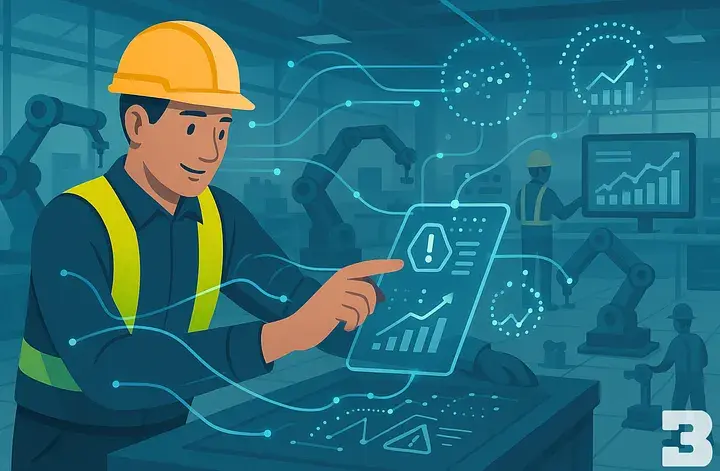
A line operator receives a recommendation from a vision-based AI agent that detects a subtle quality drift — something barely visible to the naked eye. The system suggests a minor speed adjustment. The operator reviews the data, applies their judgment about current line conditions, and decides whether to act.
A maintenance technician receives an AI-generated alert about unusual vibration patterns in a motor. They pull up the trend data, cross-reference it with their knowledge of the machine’s history, and confirm that a bearing is starting to degrade. The part is replaced during the next planned downtime, preventing an unscheduled shutdown that would have cost hours of production.
In each case, humans remain firmly in control, but they’re supported by systems that watch continuously, learn from patterns, and provide insights that would be impossible to generate manually. The operator’s intuition and the AI’s data-driven insight reinforce each other, connecting practical experience with empirical evidence.
Changing Roles, Not Replacing Them
As AI embeds itself into daily operations, the nature of manufacturing work is evolving — quietly but significantly.
New hybrid roles are emerging across the industry:
Process translators who bridge the gap between shop floor operations and data analytics, helping teams understand what the models are telling them and why it matters.
AI supervisors responsible for production metrics and model performance, conducting decision audits and ensuring that AI recommendations align with operational reality.
Reliability analysts who combine decades of hands-on maintenance experience with predictive analytics tools, using both intuition and algorithms to keep equipment running.
The most forward-thinking manufacturers aren’t downsizing their workforce in response to AI. They’re redefining it. These organizations see AI as a way to elevate workers into more strategic, analytical roles rather than eliminate positions.
This evolution requires investment in people alongside technology — new training programs, clearer career pathways, and a cultural shift in how we think about technical expertise.
Preserving Knowledge Through AI
Much of the manufacturing industry’s most valuable expertise doesn’t live in manuals or databases. It lives in the heads of experienced workers — many of whom are approaching retirement.
AI offers a powerful way to capture and preserve that knowledge before it walks out the door.
When a seasoned operator corrects an AI recommendation, adjusts a parameter based on years of experience, or explains why a certain process deviation matters, that interaction can be documented and analyzed. Over time, these patterns help create a digital record of best practices — tacit knowledge made explicit and transferable.
This approach doesn’t replace veteran workers with algorithms. It ensures that their expertise can train the next generation, support remote sites, and inform decisions long after they’ve moved on.
Training itself is evolving in parallel. Digital twins and simulation environments now allow workers to rehearse complex scenarios in a risk-free setting, learning how to interpret AI insights and respond to unusual conditions before they encounter them on a live production line. It accelerates onboarding and builds confidence in working with AI systems.
Building Trust Through Transparency
Collaboration depends on trust. And trust depends on transparency.
Operators need to understand why an AI model made a certain recommendation, not just what it suggests. Managers need assurance that decisions can be traced, reviewed, and improved over time. And everyone needs confidence that when something goes wrong, accountability is clear.
That’s where governance frameworks become essential. The most effective implementations include:
Clear ownership: Each key performance indicator has a designated human decision-maker who is ultimately accountable.
Decision playbooks: Simple guidelines that explain when to follow AI recommendations, when to investigate further, and when to override based on contextual knowledge the system doesn’t have.
Regular review sessions: Teams evaluate model performance together, discussing false positives, missed alerts, and opportunities to improve both human and machine decision-making.
Human-in-the-loop governance ensures that AI remains a decision partner, not an unchecked authority. It preserves human judgment while scaling machine intelligence. And it creates a feedback loop that makes both humans and algorithms better over time.
Without this transparency, AI systems risk becoming black boxes that erode trust rather than build it.
What Success Requires
The transition to human-AI collaboration isn’t automatic. It requires deliberate investment and cultural change.
Technology that fits existing workflows: Systems need to integrate with current tools and processes rather than requiring wholesale replacement of infrastructure. If AI adds friction instead of reducing it, adoption will fail.
Training that’s continuous, not one-time: Workers need ongoing support to develop AI literacy — understanding what models can and can’t do, how to interpret outputs, and when to trust their own judgment over algorithmic recommendations.
Management that values both: Leaders must reward both data-driven insights and experiential knowledge. If the culture only values what the AI says, human expertise atrophies. If it dismisses AI outputs, the investment is wasted.
Realistic expectations: AI won’t eliminate all problems or replace the need for skilled workers. It’s a tool that amplifies capabilities when implemented thoughtfully, not a silver bullet that automatically transforms operations.
The factories getting this right aren’t necessarily the ones with the most advanced technology. They’re the ones that have figured out how to integrate AI into their culture in ways that respect and enhance human expertise.
The Path Forward
The factories that thrive in this next era won’t be the most automated. They’ll be the most collaborative.
By combining human judgment with machine intelligence, manufacturers can create workplaces that are more productive, more adaptable, more resilient, and more rewarding to work in.
This isn’t a distant future — it’s happening now in plants that have committed to building these capabilities deliberately and thoughtfully. The technology exists. The challenge is organizational: building the training programs, governance structures, and cultural foundations that allow humans and AI to work together effectively.
The future of manufacturing isn’t human or machine — it’s human and machine working in partnership.