






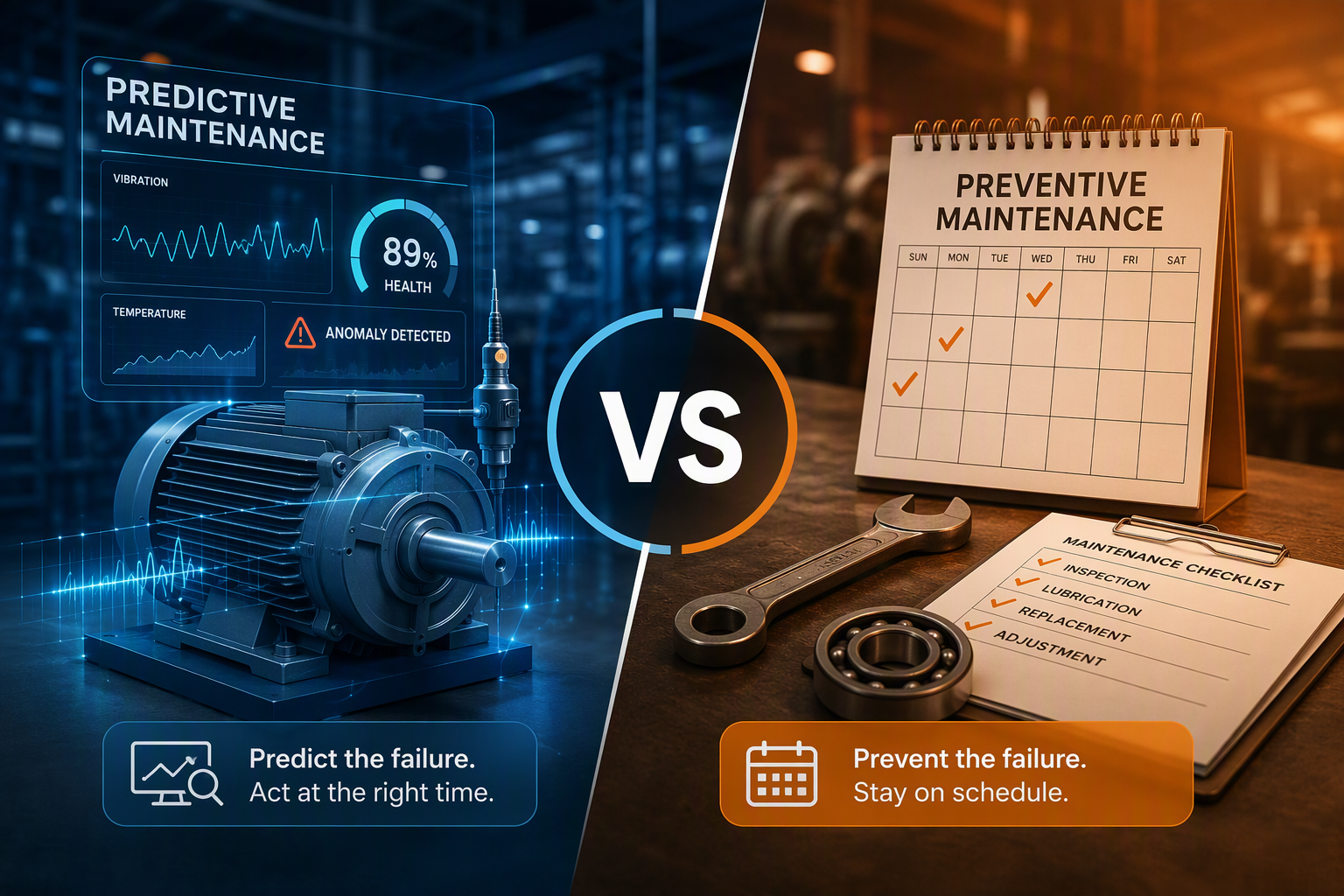
For decades, preventive maintenance has been the standard approach—servicing equipment at fixed intervals to reduce the risk of failure. Today, advances in sensors, industrial connectivity, and AI are enabling a different approach: predictive maintenance, where maintenance is performed based on the actual condition of an asset rather than a calendar date.
What Is Preventive Maintenance?
Preventive maintenance, sometimes called preventative maintenance, is a proactive approach where maintenance work is planned before equipment fails. It typically includes routine inspections, lubrication, cleaning, calibration, part replacement, filter changes, and scheduled servicing. Fluke defines preventive maintenance as regularly scheduled maintenance designed to optimize asset performance, reduce downtime and unexpected failures, and extend asset life.
The U.S. Department of Energy’s operations and maintenance guide defines preventive maintenance as actions performed on a time- or machine-run-based schedule to detect, prevent, or mitigate degradation and sustain useful life.
In business terms, preventive maintenance helps organizations create a predictable maintenance rhythm. Teams can plan labor, parts, downtime windows, and compliance activities in advance. This makes preventive maintenance especially useful for assets with known wear patterns, manufacturer-recommended service intervals, regulatory inspection requirements, or low-to-moderate operational risk.
What Is Predictive Maintenance?
Predictive maintenance is a data-driven maintenance strategy that monitors the actual condition of equipment and uses analytics to predict when maintenance should happen. IBM explains that predictive maintenance builds on condition-based monitoring by continuously assessing asset condition, collecting real-time sensor data, and using AI-enabled asset management, CMMS, analytics, and machine learning to identify and address issues. NIST defines predictive maintenance as maintenance initiated from predictions of failure made using observed data such as temperature, noise, and vibration.
The key difference is timing. Preventive maintenance asks, “Is it time to service this asset?” Predictive maintenance asks, “What is this asset’s current condition, and when is it likely to fail?” Microsoft’s predictive maintenance reference architecture describes modern systems as combining IIoT events, asset metadata, maintenance history, cost information, real-time dashboards, ML models, and technician notifications to support equipment failure prediction and intelligent maintenance operations.
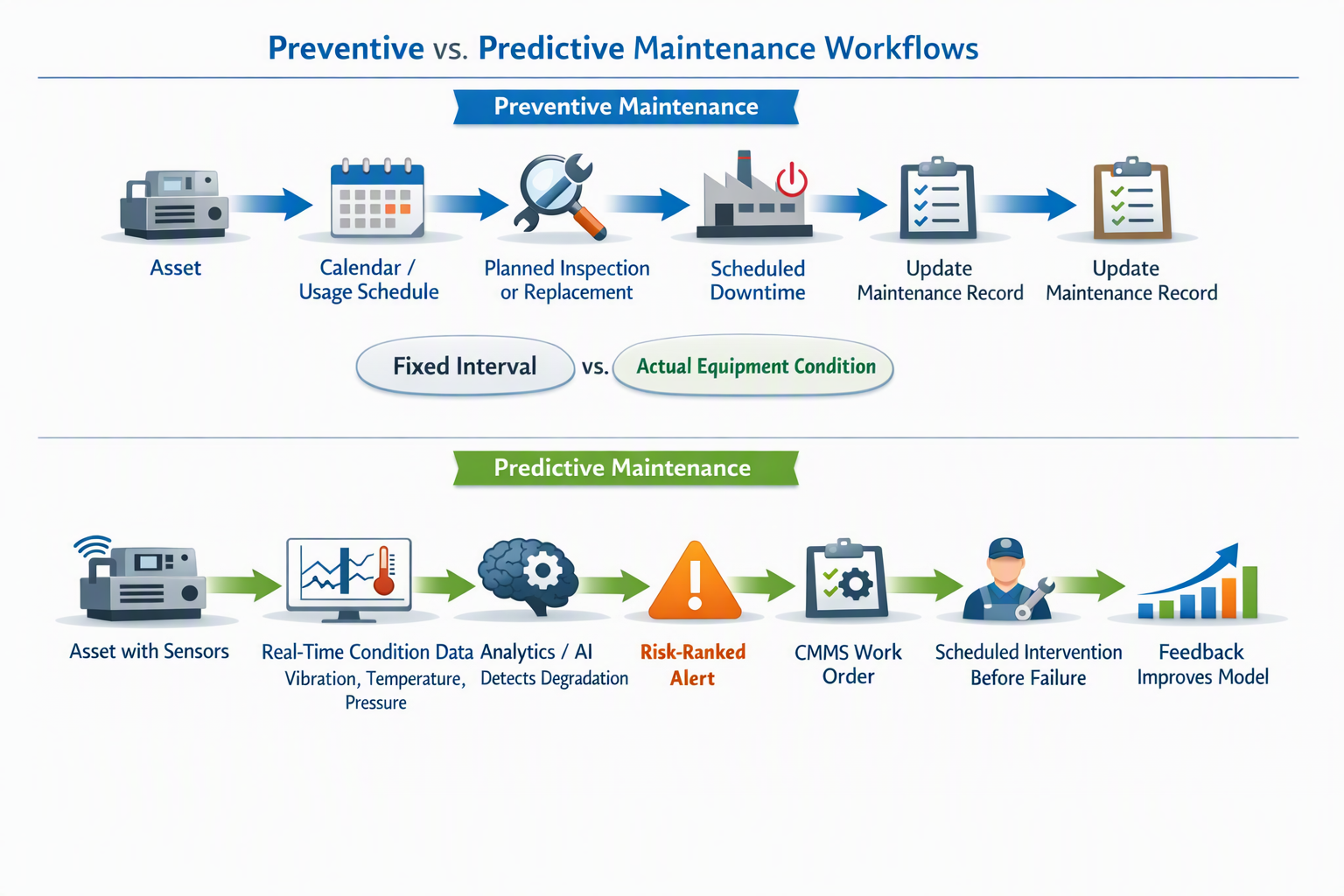
The diagram below shows the practical workflow difference: preventive maintenance is triggered by a fixed interval, while predictive maintenance is triggered by actual equipment condition and analytics.
Predictive vs Preventive Maintenance: Key Differences
| Category | Preventive Maintenance | Predictive Maintenance |
|---|---|---|
| Primary goal | Prevent failures through scheduled upkeep. | Predict failures early and intervene only when needed. |
| Trigger | Time, usage, cycles, calendar schedule, OEM guidance. | Actual condition data, sensor readings, trend analysis, anomaly detection, ML predictions. |
| Data requirements | Basic asset records, service history, checklists, schedules, CMMS work orders. | Real-time and historical data from sensors, PLCs, SCADA, CMMS, work orders, quality systems, and operating context. |
| Technology needs | Lower technology requirement; often managed through a CMMS, spreadsheet, or scheduled work-order system. | Higher technology requirement; may require sensors, IIoT infrastructure, analytics, AI/ML models, data integration, dashboards, and alerting. |
| Cost profile | Lower initial setup cost, but can create unnecessary labor, parts, and downtime if assets are serviced too early. | Higher initial setup and skills requirements, but can reduce unnecessary maintenance and better target high-impact interventions. |
| Best suited for | Assets with predictable wear, known service intervals, compliance needs, or lower failure impact. | Critical assets with expensive downtime, variable operating conditions, unpredictable failure patterns, or high safety/quality impact. |
| Main risk | Over-maintenance, under-maintenance between intervals, and missed hidden failures. | Poor predictions if data quality, sensor coverage, historical failure data, or operational adoption is weak. |
| Operational impact | More planned maintenance windows and predictable schedules. | More targeted maintenance windows based on actual risk and asset health. |
| Expected outcome | Fewer unexpected failures than reactive maintenance and more predictable operations. | Reduced unplanned downtime, improved asset availability, better prioritization, and more data-driven maintenance decisions. |
These distinctions are widely supported across authoritative sources: IBM identifies timing and future-condition prediction as the main difference, DOE/FEMP distinguishes preventive maintenance from predictive maintenance by schedule versus actual condition, and McKinsey highlights that predictive maintenance succeeds when organizations have the right data, technology, prioritization, capabilities, change management, and economic case.
Benefits and Limitations of Preventive Maintenance
Preventive maintenance is valuable because it is practical, familiar, and relatively easy to implement. It helps teams plan work in advance, reduce emergency repairs, improve safety, and extend asset life. DOE/FEMP notes that preventive maintenance can be cost-effective in capital-intensive processes, improve component life cycle, reduce equipment or process failure, and deliver estimated cost savings over reactive maintenance programs. Fluke also emphasizes that preventive maintenance supports continuous operation, optimal performance, and workplace safety.
The limitation is that preventive maintenance is based on assumptions. If an asset is serviced too early, the organization may waste labor, spare parts, and production time. If the asset degrades faster than expected, failure can still happen between scheduled inspections. IBM specifically notes that preventive maintenance may lead to under- or over-maintenance because schedules are based on historical data or expected conditions rather than the asset’s actual state.
Benefits and Limitations of Predictive Maintenance
Predictive maintenance helps organizations move from maintenance based on averages to maintenance based on evidence. It can detect degradation earlier, reduce unnecessary scheduled work, improve maintenance prioritization, and allow repairs to happen during planned production windows. IBM states that predictive maintenance can lower maintenance costs and reduce downtime when successfully deployed, while Microsoft describes predictive architectures that support failure prediction, maintenance optimization, cost analytics, dashboards, and automated notifications.
However, predictive maintenance is not automatically successful just because sensors or AI are installed. McKinsey identifies common barriers to scaling predictive maintenance, including insufficient or low-quality data, inadequate sensor coverage or IT infrastructure, unclear asset prioritization, missing data engineering and data science capabilities, weak change management, and poor economic return when models are too expensive to develop across many assets and failure modes. IBM also notes that predictive maintenance requires modern infrastructure, training, substantial data, and cultural change to move from predetermined schedules to more flexible operations.
When Preventive Maintenance Works Best
Preventive maintenance is usually the right starting point when assets have predictable wear patterns, clear manufacturer recommendations, or service intervals that are easy to schedule. Common examples include HVAC filter changes, vehicle oil changes, belt inspections, routine lubrication, safety-system inspections, calibration tasks, and compliance-driven checks. Fluke lists preventive maintenance examples across construction, manufacturing, fleets, IT/data centers, and healthcare, including inspections, calibration, brake inspections, firmware updates, and equipment maintenance at regular intervals.
It is also useful when predictive monitoring would be more expensive than the failure risk justifies. For example, a low-cost, non-critical asset may not need sensors or AI forecasting. In those cases, a calendar- or usage-based preventive schedule can be simpler, cheaper, and operationally sufficient. DOE/FEMP’s reliability-centered maintenance guidance similarly suggests matching maintenance approaches to asset criticality, failure pattern, and operational importance rather than applying the most advanced method everywhere.
When Predictive Maintenance Works Best
Predictive maintenance is most valuable when equipment failure is expensive, disruptive, dangerous, difficult to diagnose, or highly variable. It is especially relevant for pumps, motors, conveyors, compressors, robotic cells, fluid systems, energy-intensive equipment, rotating assets, production bottlenecks, and high-value assets where early intervention can protect throughput. IBM identifies common condition-monitoring techniques such as vibration analysis, ultrasonic acoustics, thermography, oil and lubrication analysis, and motor circuit analysis.
Predictive maintenance also becomes more attractive when organizations already have rich operational data but struggle to turn it into action. McKinsey recommends prioritizing predictive maintenance for assets that are critical to operations, have sufficient sensor coverage and retrievable historical data, and have enough past failure or anomaly behavior to support meaningful model development. Microsoft’s predictive maintenance architecture reinforces the same direction by combining IIoT equipment data, maintenance history, asset metadata, component costs, ML models, dashboards, and technician notifications.
Why AI and Digital Transformation Are Changing Maintenance
Maintenance is becoming more data-driven because industrial operations now generate large volumes of machine, sensor, workflow, maintenance, quality, and production data. IBM describes AI-based predictive maintenance as a shift from fixed schedules to real-time data, IoT sensors, and advanced analytics that forecast when machines need intervention. Microsoft’s reference architecture shows how predictive maintenance can process factory-floor IIoT events, enrich them with asset and maintenance context, train and score ML models, visualize equipment state, and activate alerts to technicians.
AI is also changing how teams interact with maintenance knowledge. McKinsey notes that generative AI tools can accelerate data analysis, predict potential failures, automate routine tasks, retain critical knowledge, improve troubleshooting, and make maintenance documentation easier to access. This matters because many organizations are dealing with more complex machines, more sensors, advanced software, skill gaps, and the loss of experienced maintenance knowledge as workers retire or move roles.
How to Choose the Right Maintenance Strategy
Start by segmenting your assets. Ask which assets are critical to production, safety, quality, customer delivery, and cost performance. Assets with predictable wear and manageable downtime may be handled effectively with preventive maintenance. Assets with high downtime cost, unpredictable failure modes, or significant production impact are better candidates for predictive maintenance.
Next, evaluate data readiness. Predictive maintenance needs reliable data from sensors, machine telemetry, PLCs, CMMS work orders, operator logs, quality systems, downtime records, and historical failure patterns. If that data is fragmented or inconsistent, the first step may be data integration and operational visibility rather than advanced AI modeling. McKinsey warns that insufficient, inaccessible, or low-quality data is one of the major barriers to predictive maintenance at scale.
Finally, connect insights to action. A prediction is only valuable if it changes what the organization does. McKinsey emphasizes that predictive maintenance systems must drive field actions, often through integration with digital work management systems, work orders, and feedback loops. Microsoft similarly describes predictive maintenance workflows that move from real-time monitoring and ML predictions to dashboards, technician notifications, automated workflows, and resource allocation.
Where B3 Fits
B3 is relevant when organizations want to move beyond isolated dashboards, spreadsheets, and disconnected maintenance tools. B3’s platform positioning is built around operational intelligence for modern manufacturing: connecting machines, systems, people, workflows, and AI into one platform for real-time visibility, trusted data, and faster decisions across sites, shifts, and production lines. B3’s platform structure includes Orion for connecting PLCs, MES, historians, ERP, maintenance systems, and other operational sources; Neo for dashboards, KPIs, alerts, trends, and performance insights; and B3rry for AI-supported anomaly explanation, operational questions, recommendations, and specialized agents across maintenance, downtime, quality, reporting, and continuous improvement.
A public B3 automotive case study shows how this approach can support predictive maintenance in practice. In that project, B3 unified production, maintenance, sensor, downtime, quality, and operator data into a centralized analytics environment for automotive fluid fill operations, helping deliver a 5% OEE improvement, an 8% year-over-year downtime reduction, and more than $700K in annual operational improvement opportunities. B3’s automotive page also positions predictive maintenance as using real-time equipment data to predict failures before they happen, prevent unplanned stops, and extend asset life.
This does not mean every organization should jump straight to AI. A credible path is to start with one recurring loss driver, one line, or one critical asset group; connect the data needed to understand the problem; build visibility into what is happening; and then layer analytics or AI where the business case is strongest. That approach aligns with McKinsey’s guidance to choose assets carefully and integrate predictive maintenance into the broader digital maintenance ecosystem.
Conclusion
Preventive and predictive maintenance are both proactive strategies, but they solve different problems. Preventive maintenance is best for structured, scheduled upkeep. Predictive maintenance is best when businesses need to understand asset condition, detect degradation early, and prioritize interventions before failures disrupt operations.
For many organizations, the smartest strategy is a hybrid model. Use preventive maintenance to create a reliable baseline for routine assets, and use predictive maintenance where downtime, quality, safety, or operating cost justifies the investment in data, sensors, analytics, and workflow integration. With the right foundation, partners, and adoption plan, maintenance can shift from a cost center to a source of operational resilience, better planning, and measurable performance improvement.
B3 can help manufacturers take that next step by connecting operational data, making performance visible, and applying AI-powered operational intelligence where it supports better decisions and faster action.
FAQ: Predictive vs Preventive Maintenance
1. What is the main difference between predictive and preventive maintenance?
The main difference is the trigger. Preventive maintenance is triggered by a fixed time, usage, or cycle-based schedule. Predictive maintenance is triggered by equipment condition data and analytics that forecast when maintenance is needed.
2. Is predictive maintenance better than preventive maintenance?
Not always. Predictive maintenance can be more effective for critical, expensive, or unpredictable assets, but it requires data, sensors, analytics, training, and workflow integration. Preventive maintenance is often simpler and more cost-effective for predictable or lower-risk assets.
3. What are examples of preventive maintenance?
Examples include routine inspections, lubrication, calibration, HVAC filter changes, belt replacement, brake inspections, firmware updates, emergency-system testing, and scheduled servicing based on calendar or usage intervals.
4. What are examples of predictive maintenance?
Examples include vibration monitoring on rotating equipment, thermography for electrical or mechanical issues, oil analysis for lubricant and wear detection, ultrasonic monitoring, motor current signature analysis, and AI-based analysis of sensor and maintenance data.
5. Does predictive maintenance require AI?
Predictive maintenance does not always require AI, but modern predictive maintenance often uses machine learning, advanced analytics, real-time sensor data, and industrial IoT systems to improve failure prediction and maintenance optimization.
6. How should a business start with predictive maintenance?
Start with assets where failure has a meaningful business impact and where enough data is available to support reliable analysis. McKinsey recommends prioritizing assets that are critical to operations, have sufficient sensor coverage and historical data, and show enough past failure or anomaly behavior to support model development.
7. Can preventive and predictive maintenance work together?
Yes. Many organizations use preventive maintenance for routine, predictable tasks and predictive maintenance for critical assets where real-time condition data can improve decision-making. IBM and Fluke both emphasize that organizations often benefit from combining maintenance strategies instead of relying on only one approach.
8. How does B3 support predictive maintenance?
B3 helps manufacturers connect operational systems, turn data into real-time visibility, and apply AI-supported recommendations across maintenance, downtime, quality, reporting, and continuous improvement workflows. B3’s public automotive case study shows predictive maintenance and operational intelligence applied to fluid fill operations, with reported improvements in OEE, downtime, and annual operational opportunity identification.
Connect
See B3 in action
How manufacturers connect data, teams, and operations on one platform.
Request a demo →Written by Yanis Sisalah, B3 Systems



Comments
Your email won't be published.