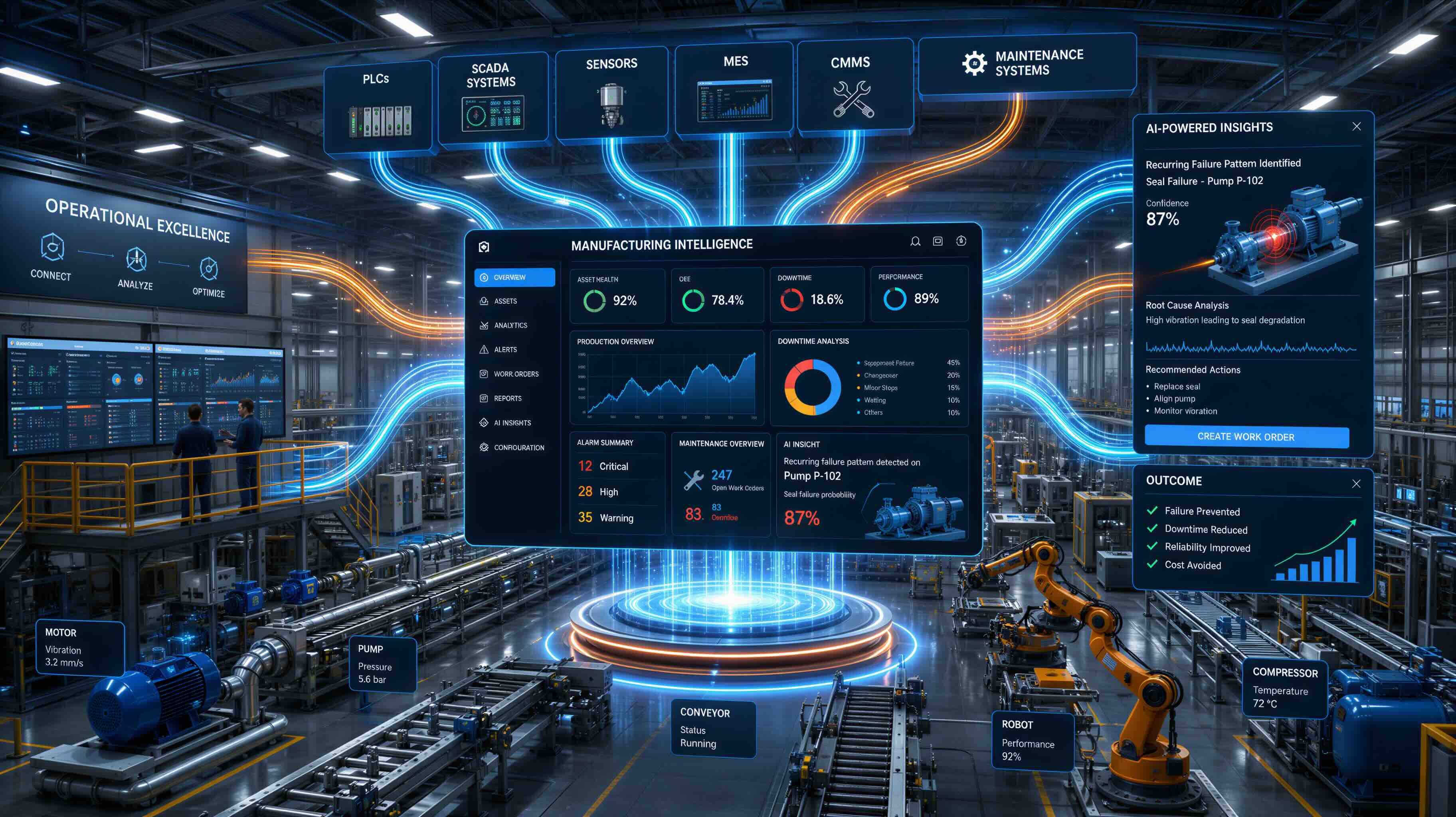

Trusted Operational Intelligence: The Foundation Industrial AI Has Been Waiting For
Manufacturers are not short on data.
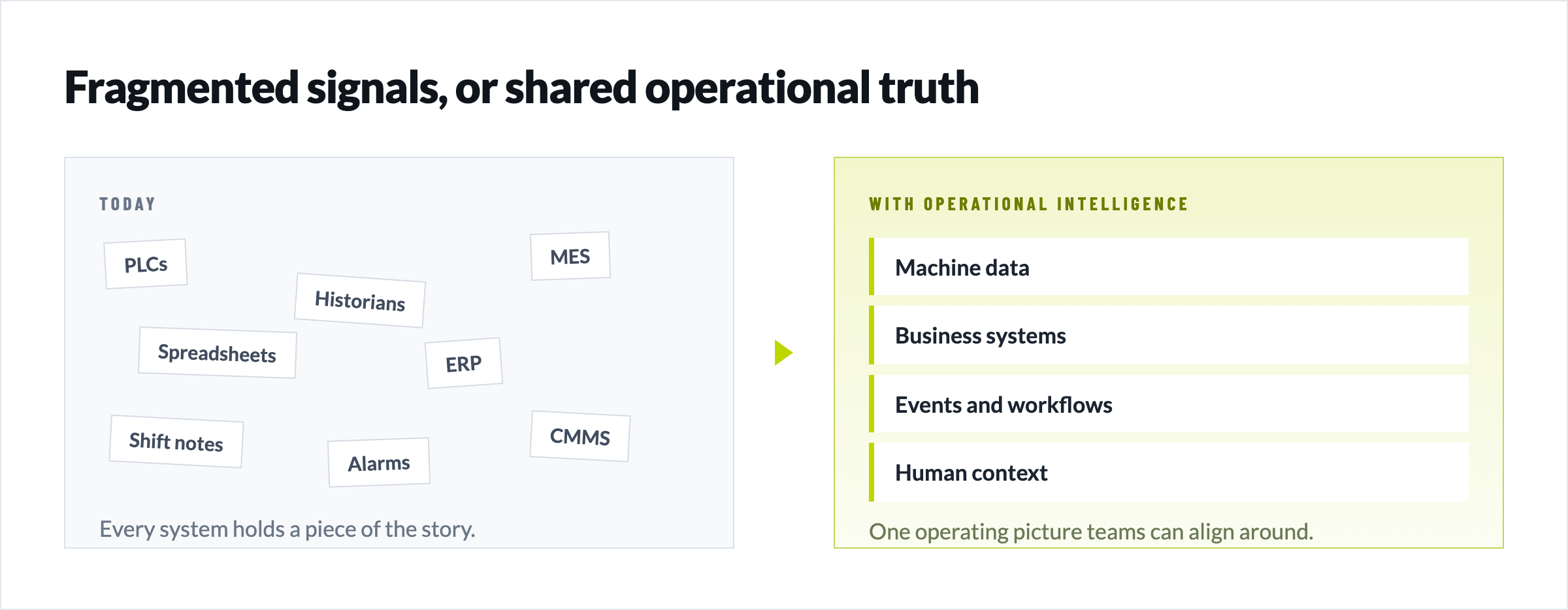
Across the plant floor, machines are producing signals every second. PLCs, historians, MES platforms, ERP systems, CMMS tools, quality systems, spreadsheets, shift notes, alarms, dashboards, and operator inputs all hold pieces of the operational story.
The problem is that the story is fragmented.
A production issue may appear first as a small deviation in machine behavior. A quality risk may show up as a pattern across process data, inspection results, and material variation. A maintenance opportunity may be visible only when work orders, alarms, sensor behavior, and downtime events are viewed together.
Most manufacturers already have the ingredients required to improve performance. What they often lack is a trusted operational intelligence layer that connects those ingredients, gives teams a shared view of what is happening, and helps them act with confidence before small issues become costly problems.
That is the next frontier of industrial AI.
Not AI as a standalone experiment. Not another dashboard. Not another disconnected analytics tool.
AI that is grounded in operational reality.
AI Value Starts With Context
In manufacturing, context is everything.
A data point is rarely meaningful on its own. A temperature reading matters because of the asset, product, recipe, shift, operating mode, maintenance condition, and downstream impact connected to it. A downtime event matters because of what happened before it, who responded, what action followed, and whether the same pattern has appeared before.
This is why generic AI has limits in industrial environments. A model can summarize information or detect a pattern, but it cannot support a trusted operational decision unless it understands the environment behind the data.
Manufacturing leaders should be asking a practical question:
Can our AI understand how our operation actually runs?
If the answer is no, the organization is not building operational intelligence. It is adding another layer of technology on top of disconnected information.
The most valuable industrial AI systems will not be defined by model sophistication alone. They will be defined by the quality, structure, trust, and context of the operational data beneath them.
From Fragmented Signals to Shared Operational Truth
Every manufacturing organization has its own operating language.
Assets have names. Lines have behaviors. Shifts have routines. Teams have workarounds. Processes have exceptions. KPIs have definitions that may vary by plant, department, or report. When those relationships live across disconnected systems, teams spend too much time reconciling information and not enough time improving performance.
That creates a familiar pattern:
- The plant floor sees the issue first.
- Engineering investigates after the fact.
- Maintenance responds when the failure is already visible.
- Leadership receives the report after the opportunity to act has passed.
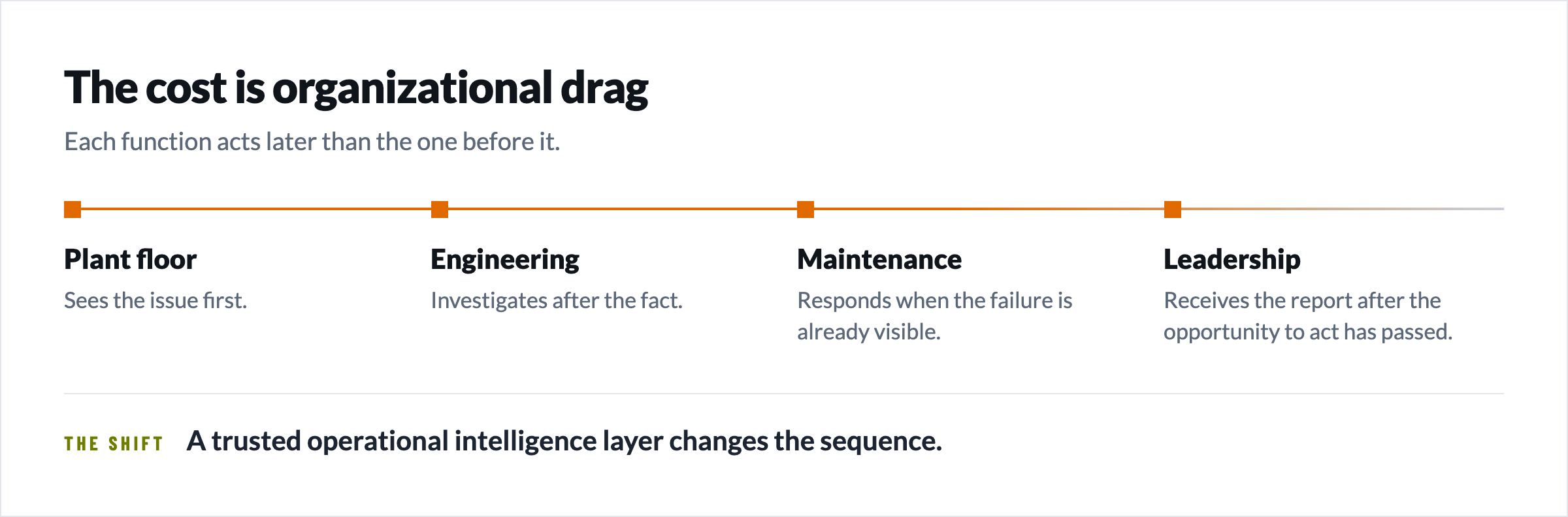
The cost is not only downtime or delayed reporting. It is organizational drag.
A trusted operational intelligence layer changes the sequence. It brings together machine data, business systems, workflows, events, and human context into a clearer operating picture. Teams can see what changed, understand why it matters, and align around the next best action.
That shared reality matters because industrial performance is cross-functional. Downtime is not only a maintenance issue. Quality is not only a quality issue. Throughput is not only a production issue. Each depends on connected decisions across people, systems, and time.
Trust Is the Adoption Challenge
Manufacturers are right to be careful with AI.
Operational data is not generic business data. It can include production patterns, process tolerances, maintenance behavior, quality signals, supplier context, work orders, downtime history, and institutional knowledge built over years of experience.
If AI is going to support operational decisions, teams need confidence in how data is handled, how recommendations are produced, and where human accountability remains.
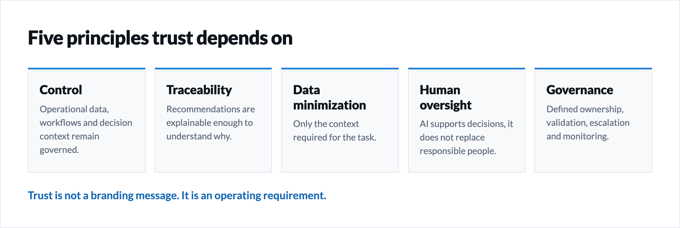
Trust in industrial AI depends on several practical principles:
Control: Teams need to know that operational data, workflows, and decision context remain governed.
Traceability: Recommendations should be explainable enough for operators, engineers, and leaders to understand why a conclusion was reached.
Data minimization: AI should use the context required for the task, not unrestricted access to everything by default.
Human oversight: AI should support decisions, not silently replace responsible people in high-impact operational workflows.
Governance: New AI capabilities should have defined ownership, permitted data scope, validation methods, escalation paths, and monitoring.
This is especially important in industrial environments because decisions can affect production, quality, reliability, cost, and safety. Trust is not a branding message. It is an operating requirement.
Why B3 Frames AI as Operational Intelligence
At B3 Systems, we believe industrial AI becomes useful when it is connected to the real operation.
That is why our platform story is built around a simple progression:
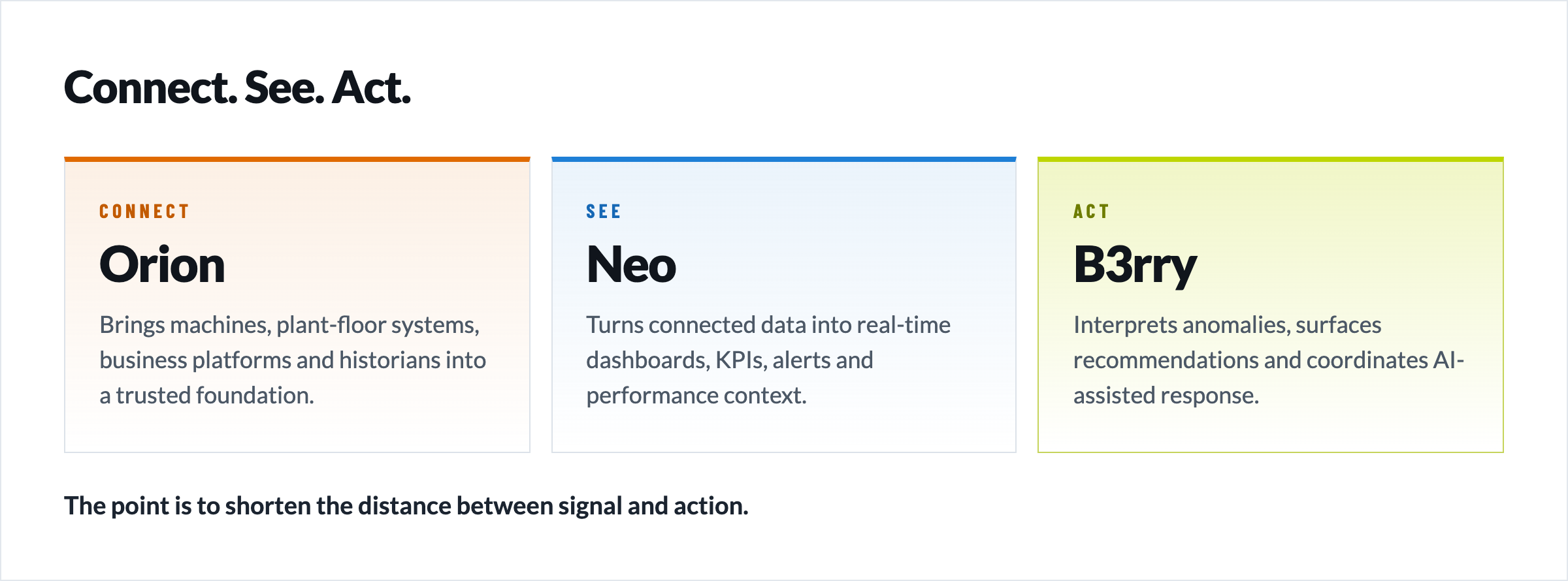
Connect. See. Act.
Orion connects the operation. It brings together machines, plant-floor systems, business platforms, historians, sensors, maintenance systems, quality sources, and operational data into a trusted foundation.
Neo makes performance visible. It turns connected data into real-time dashboards, KPIs, alerts, trends, and performance context so teams can work from the same operating picture.
B3rry turns insight into action. It helps teams ask operational questions, interpret anomalies, surface recommendations, and coordinate AI-assisted response across downtime, maintenance, quality, reporting, and continuous improvement.
The point is not to add AI for the sake of AI. The point is to shorten the distance between signal and action.
When operational data is connected, visible, contextualized, and governed, AI can become a practical decision-support layer. It can help teams investigate faster, prioritize better, and make operational knowledge easier to access across shifts, sites, and functions.
Governance Should Fit the Way Plants Already Run
Manufacturing organizations already understand governance.
They operate with standard work, maintenance procedures, safety rules, escalation paths, quality systems, change controls, and accountability structures. The future of industrial AI should build on those systems, not bypass them.
That means AI should be embedded into operational workflows with clear boundaries:
- What data can be used?
- Who can access what information?
- Which recommendations require human approval?
- How are outputs validated?
- How are actions logged?
- How does the system improve over time?
Industrial AI should not behave like an uncontrolled black box. It should behave like part of the operating system: visible, accountable, permission-aware, and designed to support the people responsible for performance.
This is where manufacturers can move beyond experimentation. AI pilots often stall because they are built around a narrow proof of concept rather than the realities of production. Scaling requires more than a model. It requires data readiness, workflow integration, user trust, governance, and a clear operational outcome.
Start With One Problem That Matters
The best path to operational intelligence is not to transform everything at once.
Start with one meaningful operating problem:
- A recurring downtime driver.
- A reporting delay that slows decisions.
- A quality issue that requires faster investigation.
- A throughput bottleneck that shifts across assets or lines.
- A maintenance workflow that needs better prioritization.
- A KPI that too many teams define differently.
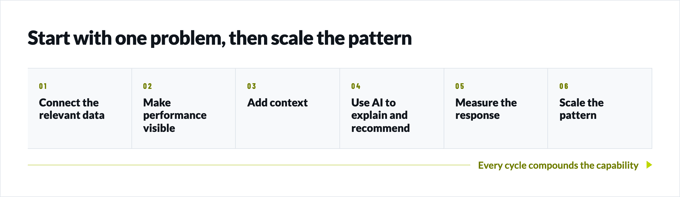
Then connect the relevant data. Make the performance visible. Add context. Use AI where it can help explain, recommend, or accelerate action. Measure whether the team can respond faster, with greater confidence, and with less manual effort.
From there, scale the pattern.
Operational intelligence is not a one-time project. It is a capability that compounds. Every connected system, every resolved issue, every validated recommendation, and every captured action can strengthen the organization’s ability to learn and improve.
The Future Belongs to Connected Operations
The next advantage in manufacturing will not come from who has the most data.
It will come from who can turn data into trusted intelligence and action the fastest.
Manufacturers already have the signals. The opportunity now is to connect them into a shared operational foundation, make performance visible in real time, govern AI responsibly, and help teams act before performance slips.
That is the promise of Operational Intelligence.
Not more noise.
Not more dashboards.
Not AI experimentation disconnected from the plant floor.
A connected operating environment where data becomes context, context becomes confidence, and confidence becomes better decisions.
B3 Systems helps manufacturers move from fragmented operational data to trusted intelligence and action — so teams can run on what is real.