A smart factory platform is the operational layer that connects PLCs, historians, MES, ERP systems, and AI into one unified environment where manufacturing teams can make real-time decisions. The challenge for manufacturers is not a shortage of data. The challenge is that production signals, maintenance records, quality metrics, and operator context sit in separate systems that were never designed to work together. B3 Systems helps manufacturers close the gap between fragmented data and faster operational action.
This article explains what a smart factory platform does, how it connects the systems manufacturers already run, and why operational context matters more than raw data collection.
Key Takeaways: What Is a Smart Factory Platform in Manufacturing
- A smart factory platform connects PLCs, MES, ERP, historians, and AI into one operational environment for real-time manufacturing decisions.
- The goal is not to collect more data but to make existing operational data visible, contextualized, and actionable across shifts and sites.
- Integration layers unify machines and enterprise systems without requiring manufacturers to replace their existing infrastructure.
- B3 Systems connects industrial systems and delivers AI-assisted decision support that helps teams act on operational context, not just dashboards.
- Real-time visibility shortens the time between a production event and the response that prevents losses from compounding.
What Does a Smart Factory Platform Do?
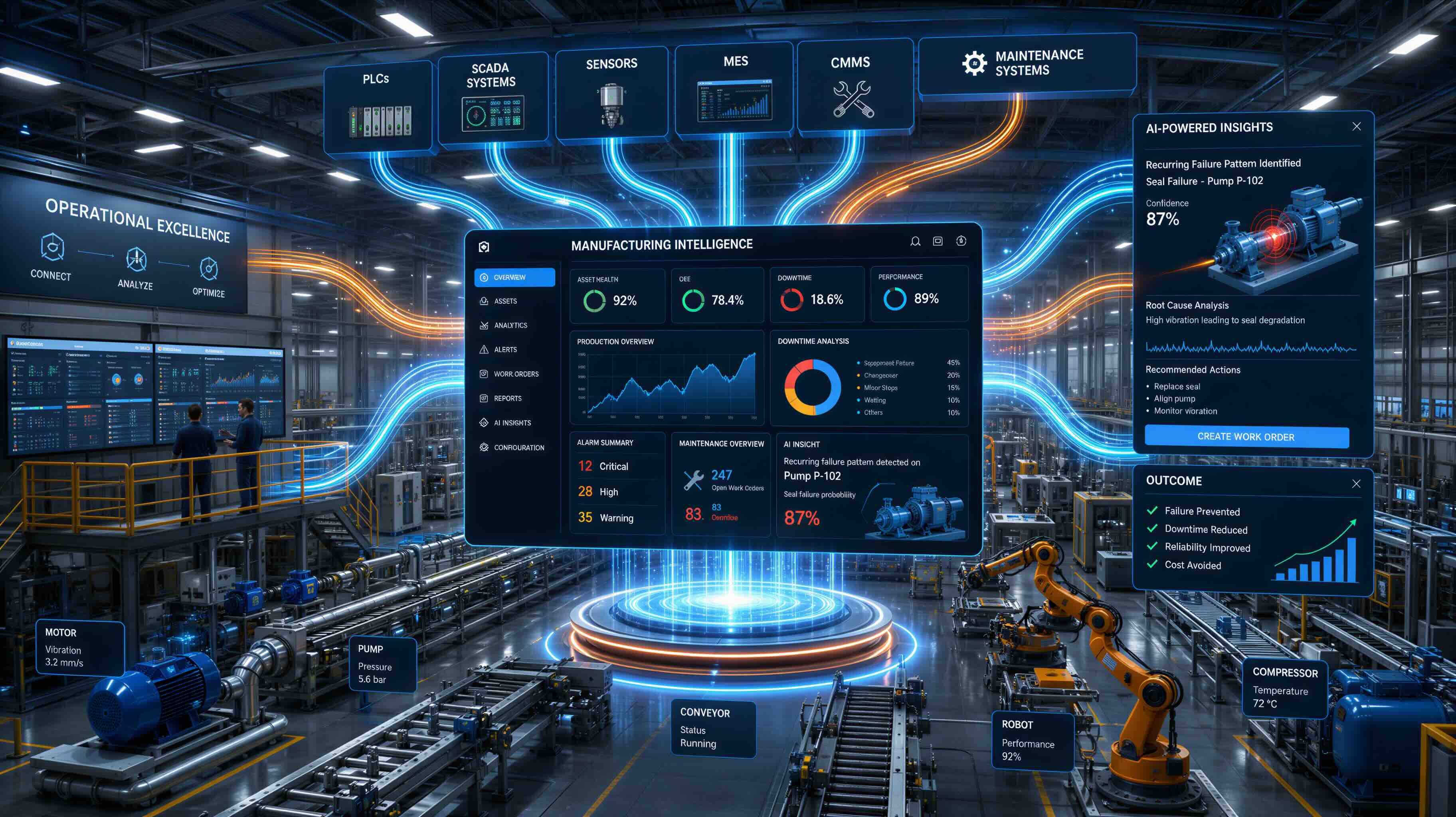
A smart factory platform serves as the connective layer between the systems that run a manufacturing operation. PLCs generate machine-level signals. Historians store time-series process data. MES tracks production workflows and work orders. ERP manages planning, inventory, and financial data. Each of these systems holds part of the operational picture, but none of them were designed to share context with the others.
The platform brings these systems together so that when a downtime event occurs, teams can see not only that the line stopped but also what changed in the process data, what alarms preceded the event, and what maintenance actions were logged. That context is what turns data into action.
Why PLC, MES, ERP, and AI Integration Matters
In many facilities, the data already exists across PLCs, historians, MES, and ERP systems. The problem is that it takes too long to pull that data together when a decision needs to be made. A quality issue appears. An operator sees a trend on one screen but needs to open three other systems to understand what caused it. By the time the full picture emerges, the loss has already moved through the production plan.
Integration matters because it reduces the gap between signal and action. When PLC data, MES context, and ERP constraints are connected into one operating picture, teams can troubleshoot faster, identify recurring conditions, and respond before small issues become larger losses.
How Data Flows Through a Smart Factory Platform
Data flows from the machine level upward through three connected layers. First, an integration layer collects signals from PLCs, SCADA systems, historians, and other operational sources. This layer normalizes the data so that a tag from one line means the same thing as a tag from another.
Second, an information layer turns that connected data into dashboards, KPIs, alerts, and trends. Operators and engineers can see what is happening across the operation in real time, filtered by line, shift, crew, or product.
Third, an intelligence layer applies AI-assisted reasoning to explain anomalies, surface root causes, and recommend next actions. This layer supports human decision-making rather than replacing it. Teams can review the evidence, question the recommendation, and act with context.
The Difference Between Visibility and Operational Action
Dashboards show that downtime increased. They do not always explain which recurring condition is driving the loss. A smart factory platform is built to close that gap. It connects the events, the process data, the maintenance history, and the operator response into one view so teams can understand not just what happened, but why it happened and what to do next.
Visibility is necessary, but it is not sufficient. The next advantage in manufacturing will come from reducing the distance between signal and action, not from adding more screens to monitor.
What Systems Connect to a Smart Factory Platform?
A smart factory platform typically connects to PLCs and programmable automation controllers, SCADA systems, historians, MES, ERP, CMMS or maintenance management systems, quality management systems, energy meters, and manual data sources like operator logs and spreadsheets.
The goal is not to replace these systems. It is to unify the data they generate so that teams can work from one consistent source of truth. For a pulp and paper mill, that might mean connecting historian data, alarms, maintenance records, grade context, and operator logs so teams can identify recurring conditions before they become sheet breaks. For an automotive plant, it might mean linking PLC data with MES production orders to trace quality issues back to specific line conditions.
How AI Supports Real-Time Manufacturing Decisions
The best use of AI in manufacturing is not to remove people from the decision. It is to reduce the time and effort required to make a good decision. Manufacturing teams do not need AI that sounds impressive in a demo but fails when applied to real operating conditions. They need practical decision support that works with the infrastructure they already have.
AI agents can monitor operational data around the clock, triage issues based on impact and urgency, and recommend clear line-level actions. B3rry, for example, coordinates specialized agents across downtime, maintenance, quality, reporting, and continuous improvement. Teams receive guidance they can review and act on during the next shift.
Where Smart Factory Platforms Add Operational Value
Operations leaders often ask where to start. The starting point is usually simple: one line, one recurring loss driver, and one measurable outcome. A smart factory platform can help identify top downtime causes, surface quality trends tied to specific process conditions, standardize KPIs across plants, reduce manual reporting time, and shorten the feedback loop between operators and engineers.
The value comes from context, not just connectivity. When teams understand what changed and why, they can act faster and with greater confidence. That is the role of operational intelligence in complex manufacturing environments.
How to Evaluate a Smart Factory Platform
When evaluating a smart factory platform, consider how it connects with the systems you already run. Does it require a full infrastructure replacement, or is it built to work with existing PLCs, historians, MES, and ERP? How quickly can it be deployed to a production environment? What level of AI governance and traceability does it offer?
Also consider the operational context it offers. A dashboard that shows numbers is not the same as a platform that helps teams understand what changed, why it matters, and what to do next. The platforms that deliver lasting value are the ones that support human judgment rather than trying to automate it away.
In Conclusion: How a Smart Factory Platform Turns Data Into Decisions
A smart factory platform is not a dashboard. It is not a data lake. It is the operational layer that connects your PLCs, MES, ERP, historians, and AI into one environment where your team can see what is happening, understand why it matters, and act with context.
The data is already there. The signals are already speaking. The opportunity is to connect those signals into an operating picture that helps teams make faster, better decisions. That is the gap operational intelligence is built to close. Not as a broad transformation promise. Not as another disconnected pilot. As a working system that supports the people who run your operation every day.
FAQs About Smart Factory Platforms in Manufacturing
What is the difference between a smart factory platform and an MES?
An MES tracks production workflows, work orders, and execution. A smart factory platform sits above the MES and connects it with PLCs, historians, ERP, maintenance systems, and AI. B3 Systems unifies these sources so teams get one operating picture rather than switching between disconnected tools.
Do I need to replace my existing systems to use a smart factory platform?
No. A smart factory platform is designed to connect with the infrastructure you already run. B3's Orion layer integrates with existing PLCs, historians, MES, and ERP systems without requiring you to rip and replace your current environment.
How long does it take to deploy a smart factory platform?
Deployment timelines vary based on complexity, but many manufacturers see measurable results within 8 to 12 weeks of a production trial. B3 Systems follows a phased approach that moves from technology assessment to production trial to full AI deployment.
What industries benefit from smart factory platforms?
Smart factory platforms deliver value across discrete and process manufacturing. B3 Systems works with automotive, steel, mining, wood products, pulp and paper, oil and gas, packaging, and CPG manufacturers to connect operational data and improve real-time visibility.
How does AI fit into a smart factory platform?
AI offers decision support by analyzing connected operational data, identifying anomalies, and recommending actions teams can review and act on. B3's AI agents work under human guardrails, helping teams reason through operational context rather than trusting a black box.