
Canadian manufacturers spent the last two years running proof-of-concept projects. Most have little to show for it. The reasons are more instructive than the results.
Ontario’s manufacturing sector pulled in more than $100 million in venture capital last year. At the same time, data tracking AI adoption across the sector shows momentum has slowed considerably. Those two facts sitting side by side say something important: investment in the idea of AI and actual deployment of AI are not the same thing.
Over the past year, we’ve had a lot of conversations with manufacturers who fall somewhere in the middle. They ran pilots. They hired consultants. They integrated tools. And then, after several months, they stepped back, not because they lost faith in AI, but because they couldn’t point to anything it had changed.
That pattern is worth examining carefully, because the problem is rarely the technology.
The proof-of-concept gap
When AI became impossible to ignore in 2023, most industries responded the same way: they experimented. Manufacturing was no exception. Companies launched proof-of-concept projects, often with general-purpose tools applied to specific operational questions. Can this model predict machine failures? Can it flag quality defects faster than a human inspector?
In isolation, many of those POCs worked fine. The model ran. The predictions came out. But somewhere between a successful pilot and a business result, things broke down.
Part of that is structural. A proof of concept is designed to answer, “can this technology do X?” What it rarely answers are “what does it take for X to create value in this specific environment?” The gap between those two questions is where most manufacturing AI projects quietly die.
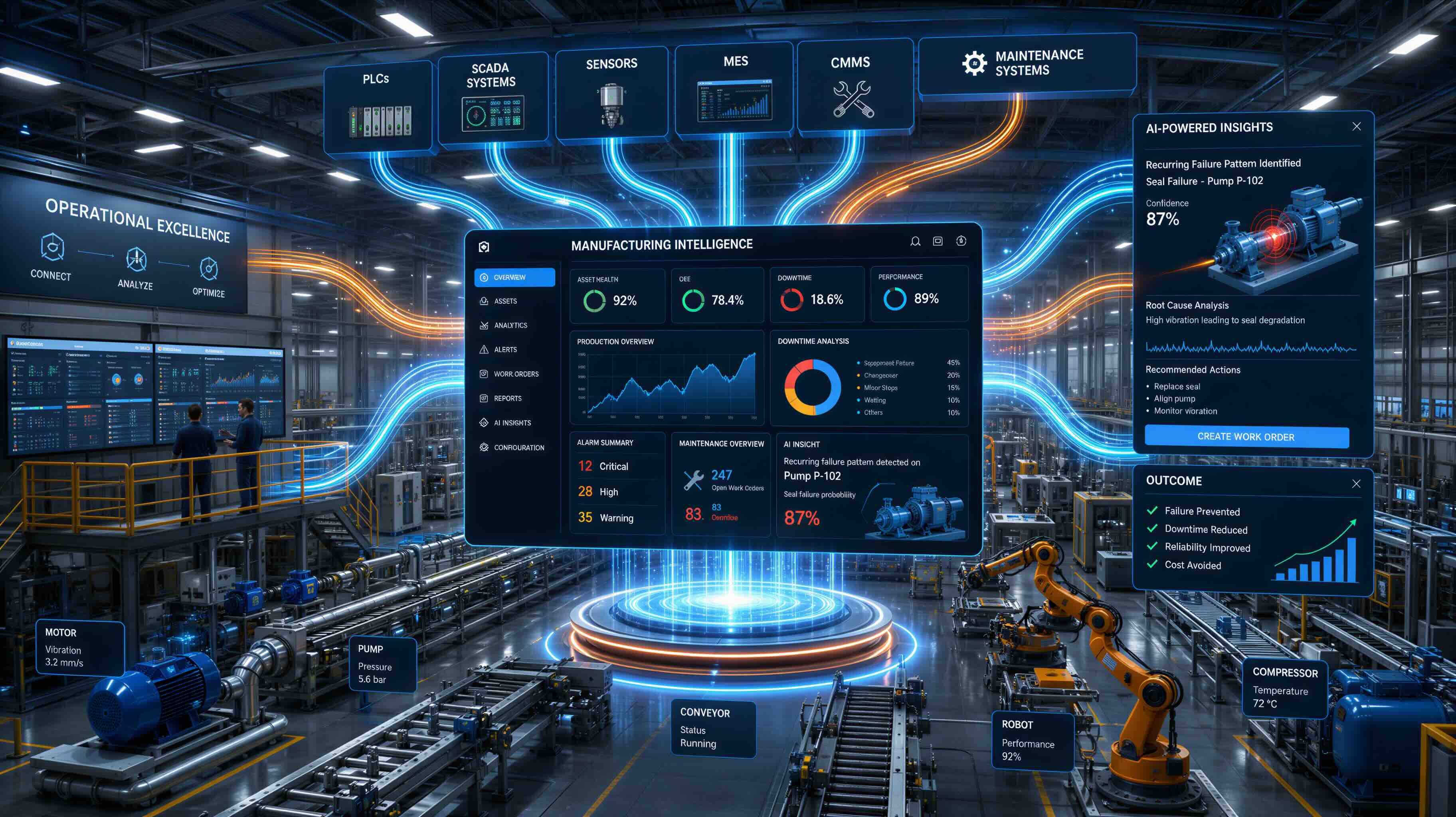
In a production environment, that gap has real texture. A model that predicts a machine anomaly is useful. A model that predicts an anomaly, surfaces it to the right person, connects it to scheduled maintenance windows, and accounts for current production targets is what prevents unplanned downtime. The first version is a demo. The second is an operational tool.
“They liked what AI could do for their industry. But to get the value out of it, they needed to talk to people who understood both sides.”
General-purpose AI tools aren’t built for that second version. They’re built to be broadly applicable, which makes them flexible but shallow in any specific domain. A manufacturer running them on shop floor data is asking a generalist to do a specialist’s job.
What manufacturing AI needs to understand
To be genuinely useful in a manufacturing environment, an AI system needs domain knowledge that goes beyond pattern recognition. It needs to understand the context that gives patterns meaning.
That means knowing what OEE represents and why it matters more than raw throughput in certain production contexts. It means understanding the difference between a gradual bearing degradation signal and sensor noise. It means knowing that a quality flag at 2am on a Friday looks different from the same flag on a Monday morning, because the downstream response available in each case is different.
This is the kind of knowledge that gets built over years of working inside the domain, not by training a language model on generic industrial datasets. The manufacturers who have had the most success with AI are the ones who either built that knowledge internally over time or partnered with people who already had it.
That’s also why the rollout matters as much as the model. Even a well-trained system will fail if it surfaces insights in a format that doesn’t fit how decisions get made on the floor. Recommendations must reach the right person, in a format they can act on, now they’re useful. A report generated overnight about a problem that happened at 3am is not operational intelligence.
The shift from monitoring to intervention
Most first-generation manufacturing AI sat in observation mode. It watched. It flagged. It reported. The human on the other end decided what to do with that information. That design made sense as an entry point, because it kept risk low and built trust gradually.
What’s changing now is that manufacturers are starting to ask a harder question: if the AI knows what needs to happen, why does a human need to be in the loop for every decision?
The answer isn’t that humans should be removed from the process. It’s that the nature of human involvement should shift. Instead of reviewing every alert and deciding whether to act, operators can focus on the exceptions, the situations where the system is uncertain, where multiple factors are in tension, where judgment genuinely matters. Routine interventions can happen automatically.
Some of the manufacturers we work with are already moving in this direction, asking systems to send signals back to machines directly: adjusting line speed, recalibrating equipment, modifying run parameters. The goal is longer uninterrupted production cycles without sacrificing quality. It’s a meaningful operational shift, and it’s only possible once you’ve built enough trust in the system to act on its recommendations without human confirmation at every step.
Building that trust is not instant. It requires a track record of the system being right in situations where it mattered, communicated in a way that the people using it can verify and understand. That’s one reason the pace of AI adoption in manufacturing looks slower than in other sectors. It isn’t hesitation. It’s due diligence.
In Canada specifically
There’s a tendency to frame Canada’s AI adoption pace as a weakness relative to the United States. That reading misses something.
Canada has genuine depth in AI research and talent. Institutions like the Vector Institute have contributed foundational work that shapes how models get built globally. Canadian manufacturers, by and large, are asking rigorous questions before they commit, questions about data quality, integration requirements, and what success looks like at scale. Those are the right questions.
The United States moves faster on average. But faster pilots that don’t translate into durable operational value aren’t an advantage. The manufacturers who come out of the current period in the strongest position will be the ones who figured out how to deploy AI that works, not the ones who deployed it the quickest.
What a more grounded approach looks like
The manufacturers who are getting real results from AI right now tend to share a few things in common.
They started with a specific operational problem rather than a technology investment. They measured success in operational terms, downtime reduced, defect rates lowered, maintenance costs avoided, rather than in terms of how sophisticated the model was. And they treated the first deployment as the beginning of a learning process, not a finished product.
They also paid attention to adoption. A system that the floor team doesn’t trust or understand won’t be used, regardless of how accurate it is. Getting operators comfortable with AI recommendations and giving them visibility into why those recommendations are being made, is as important as the underlying model quality.
The companies that skipped those steps are the ones now stepping back to regroup. The reset is not a bad thing. The first wave of manufacturing AI was always going to be a learning experience. The question is what the industry does with what it learned.