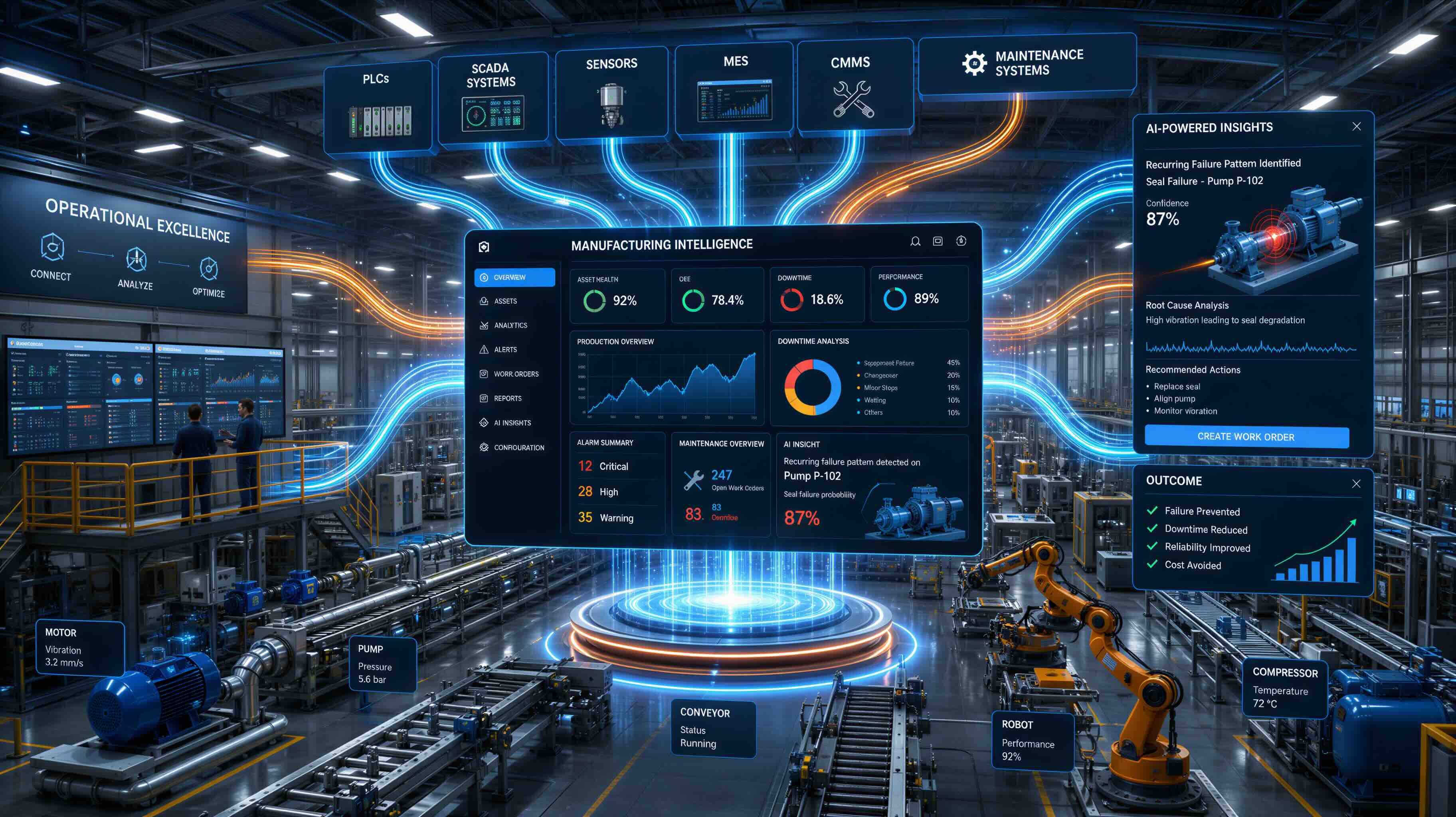

Manufacturers already have the data. PLCs, historians, MES, ERP, quality systems, and maintenance logs generate signals every second of every shift. The challenge is that this data sits in separate systems across separate plants, and none of it resolves into a single operating picture.
This guide covers what a unified industrial data foundation is, why it matters for multi-plant operations, and how to build one without ripping out legacy equipment. B3 Systems connects these disconnected systems into one operational intelligence layer so teams can act on data instead of searching for it.
You will find practical steps for connecting IT and OT systems, addressing data quality issues, establishing governance, and preparing your data foundation for AI-assisted decision support.
Key Takeaways: The Complete Guide to Unified Plant Data in 2026
- A unified data foundation connects PLCs, historians, MES, and ERP into one operating picture across all your plants.
- Legacy systems do not need to be replaced to achieve cross-plant data integration and real-time visibility.
- Data governance and standardized naming conventions are prerequisites for reliable multi-plant reporting and analytics.
- B3 Systems builds an operational intelligence layer that works with existing infrastructure to unify plant data.
- AI and machine learning require a trusted data foundation before they can support faster, more informed decisions.
What Is a Unified Industrial Data Foundation?
A unified industrial data foundation is a single layer that connects the operational systems running across your plants and standardizes their output into a consistent, trusted data set. PLCs, SCADA, historians, MES, ERP, quality systems, and maintenance platforms all feed into this layer.
The goal is not to replace any of these systems. Each one captures a specific slice of your operation. The goal is to connect them so their data resolves into one picture that operators, engineers, and plant managers can use for faster decisions.
This is different from a traditional data warehouse or a reporting dashboard. A unified foundation gives you real-time visibility into cross-plant performance, not a batch summary delivered the next morning.
Why Do Manufacturers Need Cross-Plant Data Integration?
Multi-plant manufacturers face a specific problem. Each facility selects systems based on local needs, production requirements, and available budgets. Over time, one plant might run a historian from one vendor while another uses a competing product. Mergers and acquisitions compound this fragmentation.
The result: comparing performance across sites becomes manual work. Engineers spend hours pulling reports from different systems, reconciling naming conventions, and building spreadsheets just to answer a question that should take minutes.
A 2026 Rockwell Automation report surveyed 1,560 manufacturing decision-makers across 17 countries. It found that 93% of manufacturers have MES in place, yet only 23% report full integration across ERP, PLM, quality, and OT systems.
That gap between adoption and integration reflects how difficult it is to create a unified operating picture.
How Do Industrial Data Silos Form Across Plants?
Independent System Selection at Each Facility
Plants solve immediate problems independently. A new automotive facility might install a modern MES, while an older site down the road still runs a DOS-based historian. Both generate useful data. Neither shares a common schema or naming convention.
This organic growth is normal. No manufacturing leader sets out to create data silos. The silos form naturally as each plant optimizes for local production reality.
Configuration Drift Between Identical Systems
Even when two plants run the same software, configuration differences create silos. Tag names, sampling rates, alarm thresholds, and data retention policies vary based on who set up the system and when. Two facilities running identical equipment can generate data that looks entirely different at the enterprise level.
Mergers, Acquisitions, and Organizational Splits
Acquisitions bring new systems, new naming conventions, and new data formats into the organization overnight. Reconciling these systems often takes years, and many manufacturers never fully complete the work.
What Technical Barriers Block Cross-Plant Data Integration?
Legacy Equipment and Proprietary Protocols
Older machines use proprietary communication protocols that modern platforms cannot read without specialized connectors. A plant running equipment from three decades ago often contains a mix of serial connections, custom data formats, and undocumented interfaces.
Purpose-built adapters can bridge these older systems to modern platforms without requiring hardware replacements. B3 Systems builds legacy system connectors that let aging equipment share data alongside newer assets.
Data Quality and Naming Inconsistencies
When information flows from multiple sources, inconsistencies multiply. The same metric might carry different names across systems. Timestamps may not align. Units of measurement vary from plant to plant. Cleaning and standardizing this data requires significant effort before any analysis can begin.
IT and OT Organizational Separation
IT and OT teams have historically operated with different priorities. IT focuses on security, data management, and enterprise applications. OT focuses on machine uptime, process stability, and production output. These different objectives slow integration projects when the two groups need to collaborate on a shared data architecture.
What Does Poor Data Integration Cost Your Operation?
The costs appear in multiple forms. Engineers spend hours gathering and reconciling data instead of analyzing it. Managers make decisions based on incomplete information. Quality issues take longer to trace because the data needed to identify root causes sits in disconnected systems.
Delayed visibility means delayed response. When production problems appear in batch reports the next day, the opportunity to intervene has already passed. Scrap, rework, and unplanned downtime accumulate while teams wait for information that exists somewhere in the operation.
The Rockwell Automation study found that 43% of manufacturers acknowledge they are not effectively using the data they already collect. That gap between data availability and data usability represents real operational value left on the table.
How to Build a Unified Data Foundation Without Replacing Legacy Systems
Step 1: Identify the Data That Drives Decisions
Not every tag, signal, or log needs enterprise visibility. Start by identifying the metrics that drive your most critical decisions: OEE, downtime causes, quality defects, energy consumption, throughput by line. Focus your integration effort where it will have the greatest operational impact.
Talk to the teams who use this data daily. Operators, maintenance leads, and process engineers know which metrics matter and where information gaps cause the most delay.
Step 2: Map Your Current Systems and Data Flows
Document every system generating operational data at each plant. Note the protocols used (OPC UA, Modbus, MQTT, proprietary serial), the data formats, the sampling rates, and the naming conventions. This audit reveals where the gaps and inconsistencies are.
Include business systems in this map. ERP, CMMS, LIMS, and quality management systems all hold operational context that your plant-floor data needs to become actionable.
Step 3: Standardize Naming and Data Models
Agree on a single naming convention for every metric, tag, and data point across all plants. A temperature reading on Line 3 at Plant A should carry the same label and unit as the equivalent reading at Plant B.
This standardization is the foundation for every report, alert, and AI model you build later.
Orion, the connect layer of the B3 Systems platform, helps standardize tag names and validate data values across PLCs, historians, MES, and ERP so teams get consistent metrics without manual reconciliation.
Step 4: Build Connectors to Legacy Equipment
For older equipment, build or deploy purpose-built adapters that bridge proprietary protocols to your modern data layer. The goal is to bring legacy signals into the same standardized format as newer assets without requiring hardware replacement or plant shutdowns.
Buffer locally when network links drop, then sync when connectivity returns. This approach keeps your data complete and trustworthy even in environments with intermittent connectivity.
Step 5: Stream Data in Real Time
Batch reporting worked when decisions happened daily or weekly. For operations that need to respond to issues before they escalate, real-time data streaming is essential. Moving from scheduled exports to live feeds means your teams see what is happening now, not what happened last shift.
Low-latency streaming allows plant KPIs and alerts to update as conditions change, giving operators and engineers the context they need to act sooner.
Step 6: Establish Data Governance Across All Plants
Governance defines who owns each data set, how metrics are calculated, who can access the data, and how changes are managed. Without governance, integration projects stall because teams cannot agree on what the numbers mean.
Start with a small governance committee that includes representatives from operations, engineering, IT, and quality. Document the rules, publish them where teams can find them, and enforce them through your data platform.
Step 7: Validate and Monitor Data Quality
After connecting your systems, run validation checks on the incoming data. Look for gaps, outliers, duplicate records, and mismatched timestamps. Set up automated alerts that flag data quality issues as they appear, not weeks later when someone discovers an error in a report.
The trust your teams place in the unified data layer depends on the quality of the information flowing through it. Good governance makes data reliable enough that operations leaders act on it.
What Role Does Data Governance Play in Integration Success?
Data governance is the set of rules that determines how information flows through your organization. Without clear ownership and standards, integration projects lose momentum. Someone needs to define what each metric means, how it should be calculated, and who has access to it.
Governance also addresses data quality at the source. Validation rules, standardized naming conventions, and documented data flows help prevent the inconsistencies that undermine trust in unified systems.
Consider governance as the operating agreement for your data. Just as your operation runs on standard procedures for safety and quality, your data foundation needs documented standards that every plant follows.
Why Should You Address Integration Before AI Deployment?
AI and machine learning require consistent, trustworthy data to deliver value. Models trained on fragmented or inconsistent information produce unreliable predictions. The promise of AI in manufacturing depends on solving the underlying data foundation challenge first.
Many manufacturers have run proof-of-concept AI projects that failed to scale. Often, the data foundation was the limiting factor. Without unified data, AI remains a pilot that does not reach production.
B3 Systems helps manufacturers build that data foundation. By connecting plant-floor and business systems through Orion and making performance visible through Neo, you create the conditions for AI-assisted reasoning to identify patterns, flag recurring loss drivers, and recommend actions your teams can review and act on.
How Do Different Manufacturing Sectors Approach Unified Data?
Pulp and Paper
For a pulp and paper mill, unifying data might mean connecting historian data, alarms, maintenance records, grade context, operator logs, quality results, and energy data. The goal: identify recurring conditions before they become sheet breaks.
The pulp and paper sector generates high alarm volumes. Unified data helps separate nuisance alarms from those that demand immediate attention.
Automotive
Automotive operations need tight traceability from raw materials through final assembly. Unified data connects stamping, body, paint, and assembly lines so engineers can trace a quality defect back to the exact station, shift, and process parameter that contributed to it.
Packaging and CPG
Packaging and CPG operations run frequent changeovers and short production runs. Unified data helps balance lines, reduce rejects, and speed up changeovers by giving teams visibility into performance across SKU context, line speed, and reject rates in a single view.
How to Evaluate Industrial Data Integration Approaches
Start by examining what your current systems can and cannot do. Where does data get stuck? What reports require manual effort to produce? Which decisions get delayed by incomplete information?
Consider the total cost of the approach. Rip-and-replace carries high upfront costs and significant operational risk. Platforms that work with existing infrastructure reduce both financial and operational exposure.
B3 Systems is built to connect with the systems you already run, so your teams get unified data without a multi-year replacement project.
Ask about data ownership and portability. Where will your operational data live? Who controls access? If you change platforms later, what do you take with you? These questions reveal whether an approach builds your capabilities or creates new dependencies.
What Are Common Mistakes in Multi-Plant Data Unification?
Starting Too Broad Instead of Focused
Trying to unify every data point across every plant at once is a recipe for stalled projects. The practical starting point is usually simple: one line, one recurring loss driver, one measurable outcome.
Once you prove value on a focused scope, expanding to additional lines and plants becomes easier to justify and execute.
Ignoring the People Who Use the Data
A unified data foundation only delivers value if operators, engineers, and managers trust and use it. Involve these teams early. Understand their workflows, their pain points, and the decisions they need to make faster. A technically excellent data layer that nobody uses has not solved anything.
Skipping Governance Until Later
Governance is not a finishing step. Without agreed-upon naming conventions, ownership rules, and quality checks from the start, your unified layer will inherit the same inconsistencies that made your siloed systems hard to use.
In Conclusion: Building a Unified Data Foundation That Supports Action
The data already exists across your plants. The systems generating it are already running. What is missing for many manufacturers is the connective layer that turns fragmented signals into a single, trusted operating picture.
Building that foundation does not require replacing legacy equipment or running a multi-year IT project. It starts with identifying the decisions that matter most, connecting the systems that support those decisions, and establishing governance that keeps the data reliable across every facility.
That is the role of a unified industrial data foundation. It helps teams connect what is happening across plants, understand why it matters, and act earlier with greater confidence.
If your team is working on operational visibility across plants, B3 Systems can show you how to approach a first use case.
FAQs About Unified Plant Data
What is a unified industrial data foundation?
A unified industrial data foundation is a single layer that connects PLCs, historians, MES, ERP, and other operational systems into one consistent data set. B3 Systems builds this layer through its Orion platform, connecting your existing infrastructure so teams get trusted, real-time data across every plant.
Can you unify plant data without replacing legacy systems?
Yes. Purpose-built connectors bridge older equipment to modern platforms without requiring hardware replacement. B3 Systems specializes in connecting legacy PLCs, historians, and custom systems into a unified data layer so you keep existing equipment running while gaining cross-plant visibility.
How long does it take to build a unified data layer?
Timelines vary based on the number of plants and systems involved. A focused starting point, one line and one recurring loss driver, can deliver measurable results in weeks. B3 Systems follows a phased approach, starting with a production trial in 8 to 12 weeks before scaling.
Why is data governance important for multi-plant integration?
Governance ensures every plant uses the same naming conventions, calculation methods, and access controls. Without governance, data from different sites may carry different meanings, which undermines trust and slows decision-making across the organization.
Should you fix data integration before deploying AI?
Yes. AI models require consistent, validated data to produce reliable results. B3 Systems helps manufacturers build a trusted data foundation first, then layers in AI-assisted reasoning through B3rry so teams get traceable recommendations they can review and act on with confidence.